Social dance etiquette is the set of unwritten rules that keep a floor friendly, safe and fun. In short: ask kindly, take a "no" with grace, dance with lots of people, match your partner's level, follow the flow of traffic and always say thank you.
None of this takes advanced skill. That's good news if you're new. Etiquette is the one part of dancing you can get right on your very first night.
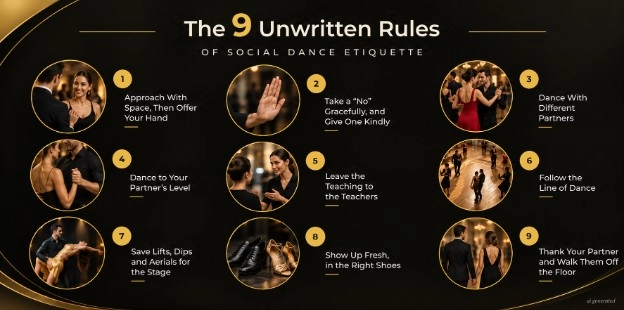
Below are 9 rules that will help you feel confident at any social event, plus why each one matters.
Social dance etiquette matters because a social is shared by many people who don't all know each other.
Good etiquette leads to three practical results:
A few terms you'll see in the rules below:
Body language starts before the first step. Walk up calmly and leave a little personal space. Don't barge into a conversation or stand too close. Wait for a natural pause so the person sees you coming.
Then offer your hand and ask out loud: "Would you like to dance?" An open hand and a spoken invitation give the other person a real choice. You can ask anyone: beginners, regulars and even the instructors.
If they say yes, let them take your hand and walk onto the floor together at an easy pace. You're inviting your partner to the floor, not dragging them there.
People turn down dances for all kinds of reasons: sore feet, a song they don't know or a needed break. Don't take it personally. Say "No problem, maybe later!" and move on to the next person you'd like to dance with.
If you decline, sit out that whole song. Saying no to one person and then dancing the same song with someone else is one of the fastest ways to hurt feelings.
If you simply don't know the dance, say so: "I'd love to, but I haven't learned cha-cha yet."
Social dance parties work best when everyone switches partners. Most people change partners after one or two songs, even if they came with a date or spouse.
Make a point of inviting newer people. They often wait near the wall, hoping someone will ask. One relaxed dance with a confident partner can decide whether a beginner comes back to the next party.
Switching partners helps you too. Each partner moves a little differently, so you learn to lead or follow more clearly than if you danced with one person all night.
Start every dance with simple basics. Watch how your partner responds during the first few bars. Then add only the figures they can follow comfortably.
If a move doesn't work, go back to your basics and try something easier. Nobody needs to apologize. The goal is a good time for both of you, not a display of everything you know.
Be mindful of your hands and body language too. Keep your hands in the correct position and hold your partner at a comfortable distance. Your partner should feel it's okay to dance with you, not uneasy. This goes both ways: leaders and
followers can each make a partner uncomfortable without meaning to.
Don't correct your partner on a social floor unless they ask. Unsolicited tips usually land as criticism, even when you mean well. Even the World Swing Dance Council’s etiquette guide says that teaching your partner during a social dance isn’t
acceptable.
There's one exception. If something hurts, speak up right away. A tight grip or a yanked arm needs fixing immediately.
If someone starts coaching you, a polite "I'd rather just enjoy dancing tonight" is perfectly fine.
This is the core of ballroom etiquette. Traveling styles move counterclockwise around the room. That path is called the line of dance, and you can think of it as a one-way road.
Styles like Cha-Cha, Rumba and Salsa don't travel around the room. For these, stay in a compact area toward the center and leave the outer lane free for couples who travel.
A few floorcraft habits that prevent most collisions:
Big tricks need space, a warm-up and a partner who agreed to them in advance. A busy social floor offers none of those.
A mistimed dip or a high kick can injure your partner or the couple next to you. The same goes for competition choreography. It's built for an empty floor, not a crowded party.
You'll be dancing close to many partners, so hygiene matters. Shower, wear deodorant, carry mints and skip heavy perfume or cologne. For long nights, bring a spare shirt.
Shoes matter as much as manners. Suede-soled shoes are ideal. If you don't own any yet, wear smooth-soled shoes that stay securely on your feet. Avoid rubber sneakers, which grip the floor and strain your knees during turns.
Most studio socials are dressy casual. Wear something you can move and turn in comfortably.

When the song ends, say thank you, even if the experience felt rough. In the traditional etiquette of ballroom dancing, the leader walks the partner back to the edge of the floor. Today, either partner can offer.
Then move on. Asking the same person for song after song can feel like pressure. If you enjoyed it, ask again later in the evening.
Want to see these rules in action? In this short video, our PRO DANCE instructors talk about how to walk up to someone, offer your hand and invite them to the floor.
Whether you’re dancing to meet new people or just for fun, these small habits make every partner feel welcome.
Watch our social dance etiquette video on YouTube:
Save this quick list for your next party:
Yes, but only a little. The basic courtesy is the same everywhere: ask kindly, respect a “no” and thank your partner. What changes is how couples share the room.
New to Salsa, Bachata or Swing? Our guide to 3 popular social dances in Playa del Rey, CA explains what makes each one unique and how to take your first steps.
Feeling nervous is normal, and it usually fades after the first few songs. Most first-timers worry about forgetting their steps. In reality, one basic pattern in two or three styles is enough to enjoy a whole evening. A simple plan helps more than extra practice.
Before the party
At the party
If something goes wrong
Missed steps happen to everyone. Smile, return to your basic and keep going. Your partner will remember how pleasant you were, not the step you missed.
The best place to practice social dance etiquette is a friendly room where everyone is still learning. At PRO DANCE Studios, you can learn to dance in Playa del Rey or Los Angeles in a welcoming environment, without pressure with U.S. Professional Ballroom Champions Iaroslav and Liliia Bieliei.
Our studio is at 177 Culver Blvd, Playa del Rey, CA 90293, a short drive from Westchester, Playa Vista, Marina del Rey and El Segundo.
Here’s how to get started:
Book your intro. Two 30-minute private lessons for $59. No partner or experience needed. Claim your intro offer.
Join a group class. Check the class schedule.
Come to a party. Put these nine rules to work at our next social dance party.
Have questions?
Call: 310-871-5452.